
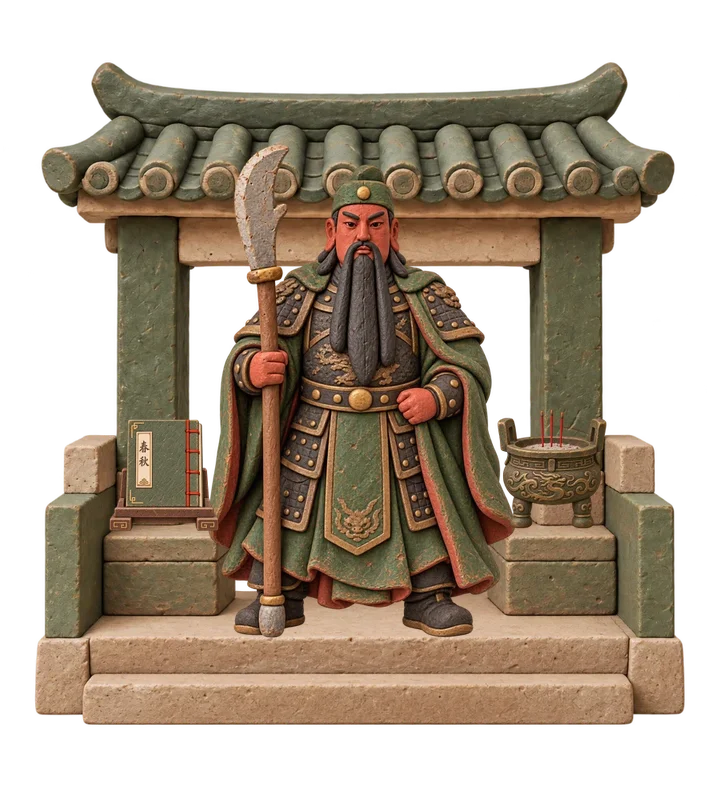
Look for the long beard, armor and polearm. Then look for a quieter detail in the miniature: a book on a reading rest. Together these choices invite a reading of loyalty as a matter of judgment and conduct as well as military strength.
How a commander became Lord Guan
關羽 · Guān Yǔ, honored as Guān Gōng or Guān Dì
Guan Yu served the warlord Liu Bei during the wars at the end of the Eastern Han dynasty. His death around 220 belongs to the history of those wars. Titles such as Lord Guan and Emperor Guan belong to later centuries of remembrance. The historical commander never ruled China as emperor.
Stories, plays and the novel Romance of the Three Kingdoms brought the friendship and obligations of Liu Bei’s circle to audiences far removed from the original campaigns. Loyalty became a way to interpret Guan Yu’s choices. An armored figure reading a book could consequently evoke moral cultivation alongside military skill.
Imperial honors gave another kind of authority to that reputation. The Ming Wanli emperor elevated Guan to imperial rank, and Qing rulers supported shrines in his honor. The Cantonese name Kwan Tai preserves the imperial title heard at temples in Hong Kong. A biography, a literary hero and a temple dedication each illuminate a different stage in that transformation.
Look closer
- British Museum · Guan Yu biography
- British Museum · Guan Yu painting and halberd
- British Museum · Guan Yu and Spring and Autumn Annals
- Hong Kong AAB · Kwan Tai and Kwun Yam Temple appraisal