
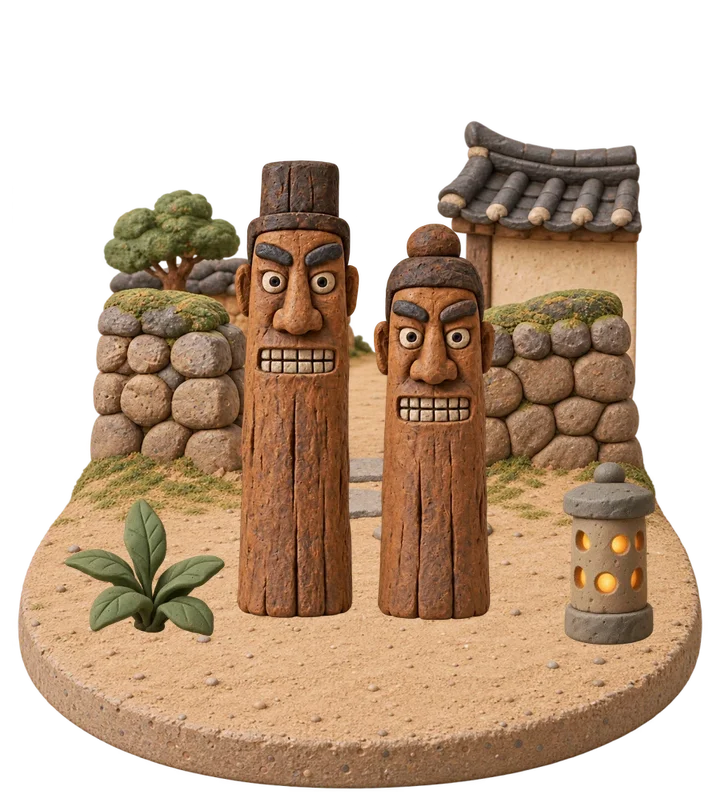
Look for the vertical post beneath each face. In Little Shrine the two forms share one entry and stand together on the path. Treating them as a pair preserves their relationship to the entrance, which would be easy to lose if the faces were displayed separately.
When a boundary marker also guarded a community
장승 · Jangseung, village guardian posts
The history of jangseung sits where travel, territorial boundaries and village protection meet. Historical scholarship compares stone markers at temple boundaries in the Goryeo period with the use of signposts during Joseon. This is a history of related objects with overlapping functions. A direct line of descent for every surviving village post would require evidence from that village.
An inscription can tell a story that the carved face alone cannot. Posts could identify a place, carry a general’s title or mark an approach. Wood also weathers and can be renewed. The age of the post standing in a photograph may therefore differ considerably from the age of the custom at its site.
A communal rite adds another layer of evidence. Accounts from Oeam describe people taking specific roles and preparing for a first-full-moon observance. Read alongside the boundary-marker history, the preparations show what it takes to maintain a village entrance across generations. In Little Shrine two posts share one entry because their position together at a threshold is part of what a viewer needs to see.
Korean Citation Index · The Origin of Changseung and Ongjung Stone