
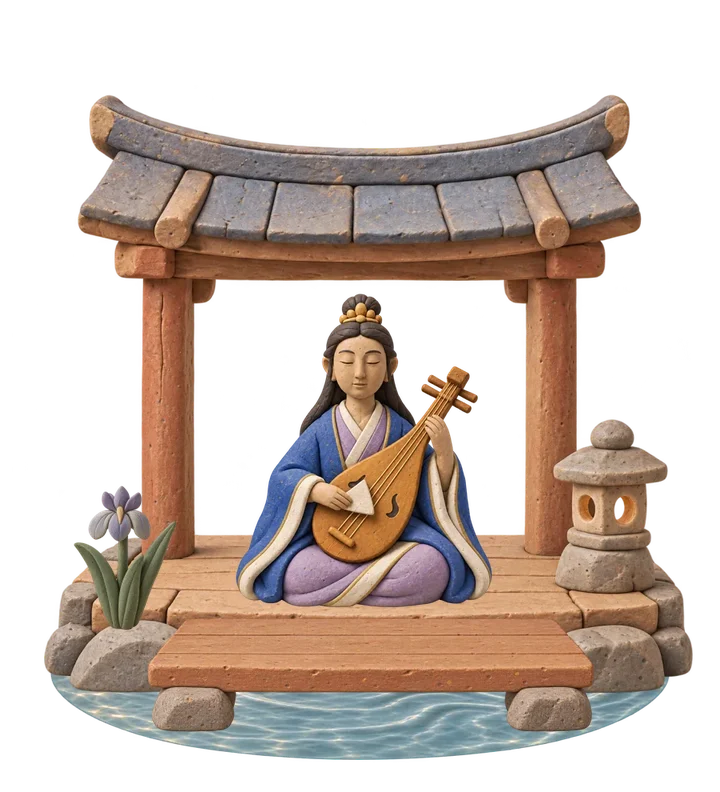
Begin with the outline of the instrument, then widen your view to the pavilion. Little Shrine uses a pond, iris and timber foredeck to link the musician’s space with its surroundings. Museum images of Benzaiten allow a closer look at the instrument itself.
The musician and the eight-armed protector
弁才天 · Benzaiten, also written 弁財天
Benzaiten’s history connects the Indian goddess Sarasvatī with the transmission of Buddhist texts and images to Japan. Speech, learning and flowing water belong to that inheritance. The familiar Japanese image holding a biwa, a short-necked lute, makes her association with music particularly easy to recognize.
Another visual tradition presents a deity with eight arms and weapons. A sixteenth-century hanging tablet in the Nara National Museum preserves this form in relief. Placing the tablet beside a picture of the lute player makes a historical point: artists selected different attributes to emphasize protection, eloquence or musical skill. The number of arms and the object in each hand change the reading of the image.
Ponds and island sanctuaries give this history a physical geography. At Hōjōike, the relationship between water and a shrine to Benzaiten is visible before the visitor sees an image of the deity. The miniature pairs an island pavilion with the musical form. The Nara tablet offers a way to encounter the protective form that the small waterside scene leaves out.
Nara National Museum · Hanging tablet with eight-armed Benzaiten
Look closer
- Japan Tourism Agency · Benzaiten, water, knowledge and music
- Kyoto National Museum · Benzaiten playing the biwa