
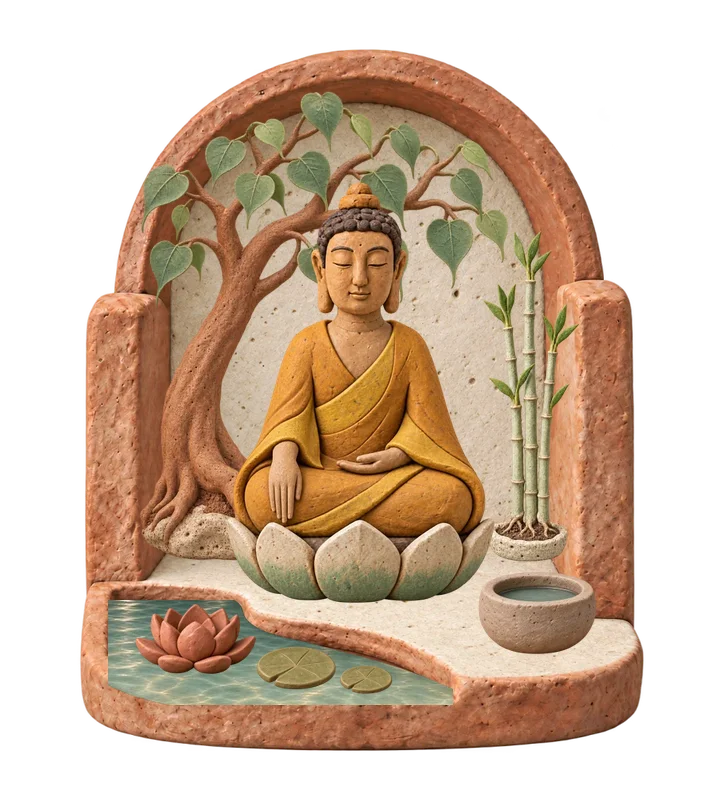
On a carved stele, several episodes of Shakyamuni’s life can surround a single central figure. Start at the central hand, then look above it for the tree. Little Shrine keeps those two clues together in its Bodhi courtyard. The bamboo and pond set the scene around them.
From a remembered life to a carved biography
Śākyamuni · The sage of the Śākya people
Śākyamuni identifies a particular Buddha, the teacher whose life early Buddhist communities located in northern South Asia. Buddha is a title meaning “awakened one.” The distinction matters when reading a museum label: an image of a Buddha may refer to a different figure, while an episode such as the awakening beneath the tree helps identify this one. Accounts of that night belong to Buddhist sacred biography.
A tenth-century stone stele from Bihar, made under the Pala dynasty, shows how artists told this life centuries after the teacher’s lifetime. Eight events share one surface. The seated figure at the center gives the awakening a different visual weight from the smaller episodes around it. A viewer could recognize the scene from the hand reaching down and the tree overhead, without reading a caption.
The stele connects a gesture to a full sequence of remembered places and events. A miniature that preserves the hand and tree keeps part of that visual vocabulary, while leaving out the surrounding life story. Look at the whole stele after the close-up to see what the small image leaves outside its frame.
Look closer
- The Met · Buddha beneath the Bodhi tree, touching the earth
- University of Michigan Museum of Art · Buddha beneath a three-leaf canopy