
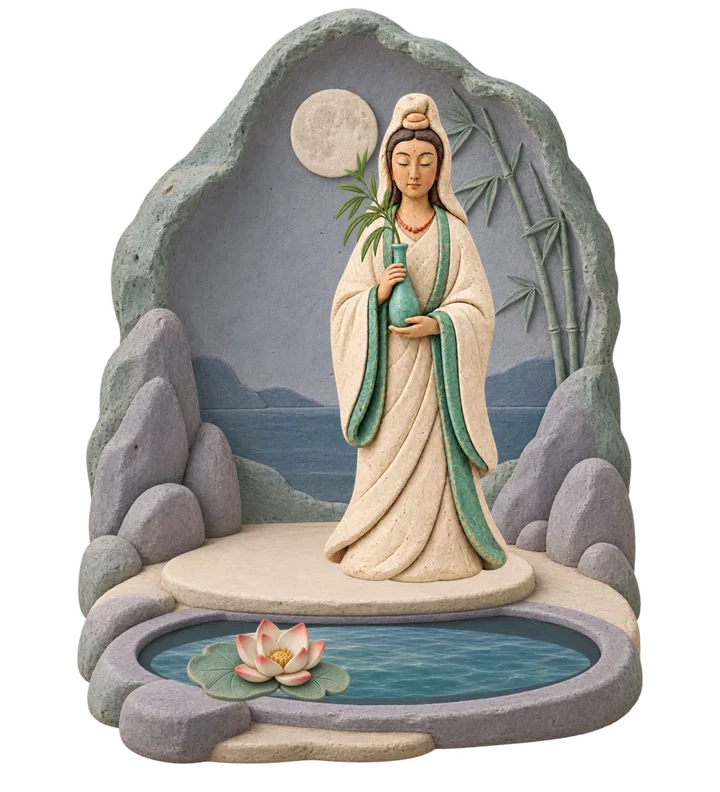
Compare the Metropolitan Museum’s sculpture with the miniature. The museum object lets you study posture in the round. In Little Shrine the grotto, moon and reflection supply the setting while the vase and willow help identify the figure. Start with the surroundings before looking for details in the hands.
How an island paradise acquired a Chinese geography
觀音 · Guānyīn, a shortened form of Guānshìyīn
Guanyin is a Chinese name for Avalokiteśvara, the bodhisattva invoked by people who turn to compassion in times of distress. The longer Chinese name evokes attending to the sounds of the world. The many forms of this figure in East Asian art reflect the many circumstances in which devotees understand that compassion to appear.
The Met dates its Water-Moon figure to eleventh-century China under the Liao dynasty. One knee is drawn up, and the body sits at ease. For viewers familiar with this form, the posture evoked Potalaka, the bodhisattva’s island dwelling. Earlier accounts located that island south of India. By the Ming dynasty, pilgrims identified it with Mount Putuo off the coast of Zhejiang.
A sacred landscape thus acquired a physical destination. A grotto and a stretch of water in a Guanyin painting can evoke both an imagined dwelling and a coast people have actually traveled to. That history gives the app’s reflected moon a more specific meaning than a general symbol of calm.
Look closer
- The Met · Water-Moon Guanyin
- University of Michigan Museum of Art · Guanyin with willow branch and vase
- Smithsonian · Guanyin with willow wand and amphora
Why do visitors offer water to Guanyin at Tsz Shan Monastery?