
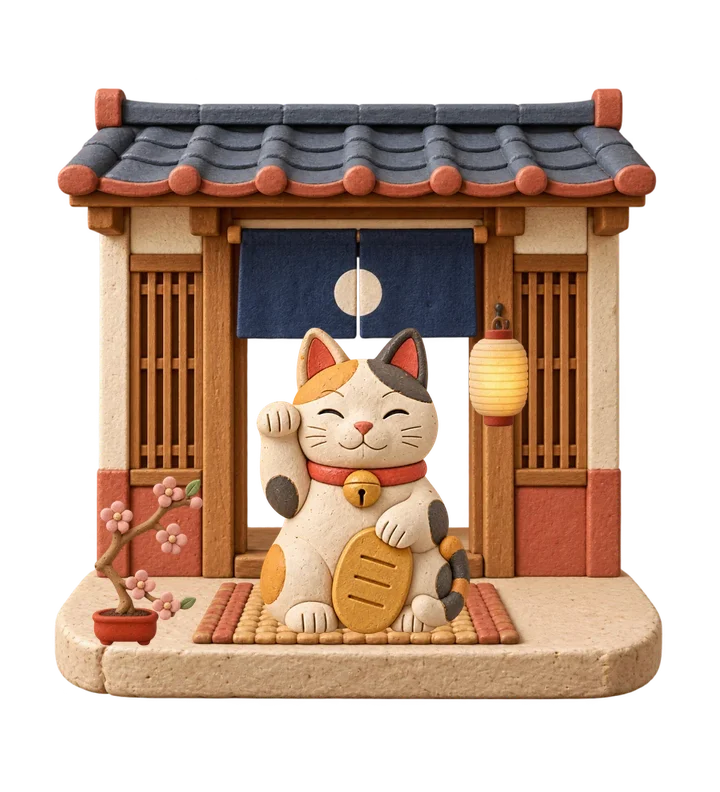
Imagine the cat at counter height facing someone coming in from the street. Its posture reads as a greeting before the visitor notices its coloring. Little Shrine frames the cat with a shop curtain and lantern to preserve that sense of arriving somewhere.
An Edo-period charm and its competing stories
招き猫 · Maneki-neko, the beckoning cat
The beckoning cat belongs to the history of Japanese auspicious objects and commercial life. Tokyo’s Omiyage Project traces the form to the Edo period, which ended in 1868. Its lifted paw is easiest to understand in a doorway: the motion is an invitation directed toward a person arriving from outside.
Several places tell stories of the cat’s beginnings. Gōtokuji preserves a temple tradition about a cat whose gesture drew a lord to the temple. That account explains the temple’s particular connection with beckoning cats. It should be read as an origin tradition of a named place, alongside the wider evidence of cats made, sold and displayed by other communities.
The object also has a craft history. Tokyo’s project profiles a present-day maker who came to the form through techniques used for hina dolls. At Gōtokuji, devotees can dedicate cat figures in gratitude. A souvenir carried home, a handmade object on a shop counter and a figure returned to the temple may look related but record different journeys.